Americans have served in ‘advisory’ roles throughout many countries in the world. In the 1960s with the advent of the Peace Corps Americans have worked in many-many countries throughout the world trying to improve the lot of the people living there. Vietnam was no different.
If there was a difference it was the fact that American advisors carried weapons, but we were not necessarily just there as soldiers. We were there as advisors to assist the Vietnamese government, its military, and its people improving their way of life.
But there was a difficulty that Americans had in dealing with the Vietnamese. One of them is just the difference in the way that we look at life. The Vietnamese looked at life from an ethical side, while we in America looked at life from a scientific side. In Vietnam the Confucian ideal of the scholar-bureaucrat gentlemen, emphasized government by people with virtuous character. In fact, on the social scale, in the Confucian ideal, a military man is considered almost by definition as one who could never aspire to be a person of virtuous character.
Again, one of the early Confucian philosophical ideals dealing with government is that government is best that governs least. I believe Thomas Jefferson made the same comment about government in the United States. In Vietnam under the rule of the emperor the emperor’s power ended at the village gate. He could order each village to pay taxes, and he could order villagers to provide soldiers for the military when needed, but the governing authority of the village rested with the village elders. This created significant issues in dealing with the villages in our district. We had military forces stationed in each of our districts; in some cases, they were militia-type units (The Peoples Self Defense Force) that were under the control of the village chief.
The district chief was a military man. He reported directly to the province chief who was also a military man, usually the rank of senior Colonel, which would be our equivalent of a brigadier general in our system of rank. But outside the military when it came time to decide what was best for the local village that decision was made by the village elders and the village chief.
In the Vietnamese the term American advisor was Cố vấn mỹ; But to the Vietnamese this term was far different than it was for Americans. In Vietnamese the term meant: to care for and to observe and hopefully contribute an opinion when asked. This is a far cry from what we think of as Americans when we talk about advising. The role of an advisor is to not just suggest but, in many cases, indicate what direction something should go in to succeed. There’s a big difference in the way that the Vietnamese looked at advisors and the way that advisers looked at themselves.
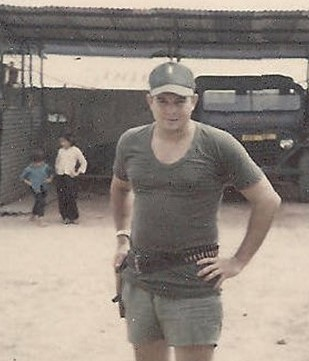
The Vietnamese were also very rank conscious. For example, I was a second Lieutenant, the lowest officer rank in the United States army. My counterparts were often Vietnamese first lieutenants and captains. Many of them had years of experience in the military. As a twenty-year old officer when I arrived in Vietnam, I had about eighteen months in the army. This included basic infantry training, my Advanced Infantry training, and my time in Officer Candidate School, as well as six weeks at the Military Intelligence Officer Basic Course. I was green, I was new, and as far as the Vietnamese were concerned, I was not proficient. As a young second Lieutenant, a Vietnamese First Lieutenant or Captain was not going to listen to me or take me seriously.
I can remember Captain Pete Wetherall telling me very distinctly that no Vietnamese officer was going to listen to a second Lieutenant. He told me, about my first day on the job with him, that my job was never to tell or demand that they do something. My role was to listen carefully and perhaps suggest something to be done. He also reminded me that I should never force the issue with them and that I pose my suggestion as that, “Sir I might suggest that we do…”. For me, as a second Lieutenant, to try to demand that they accept my solution was the worst thing that I could do. He also advised me not to be surprised that after a while they would come back to me and parrot what I had already suggested that they do; but it was now their idea rather than mine. He suggested that I praise them for developing a great idea, and never-never tell them, “I told you so”.

The captain had served as an advisor for many years, and he knew exactly what he was talking about. But for an American to suggest have someone basically say, “no that’s not a good idea”, and then come right back later and indicate that their idea was to do exactly what you used to suggested infuriated many officers. The other thing that he taught me was the fact that as a very junior officer I needed to learn how to properly introduce myself and my ideas.
The Vietnamese are indirect people. He told me that you would never start off a conversation and try to get to the point immediately. That’s just not the way the Vietnamese operated. When I met my counterpart for the first time I had some basic information about him, his family, where he was born, something about his life prior to the military, and I would use that information first. I would meet my counterpart every morning for tea and rather than discuss business we would talk about family. I would ask about his children, how his sons were; I would ask about his father if he had heard from him recently about how the family was doing and if he had an enjoyable evening. He would ask me the same if I had heard from my family; if I had received a letter from home recently. All this banter led to our initial discussions for the day, all over a cup of tea.
If we went to a local coffee house, I was expected to buy the coffee or the tea. This did have some unique ramifications with other officers that I dealt with. There was a deep sense of honor among many of them and for a subordinate to purchase tea or coffee or a gift what’s considered to be bribery even if it’s for a very small amount. So, you had to be very careful not to offend someone’s sense of honor. When I was dealing with Colonel Tua, our district chief, I brought him a bottle of cognac back from Saigon, I knew that he liked good cognac. I presented him the bottle and he wouldn’t accept it. Captain Wetherall got me off to the side and told me to go get four glasses. I opened the bottle and poured a glass of cognac for everyone. He then took the bottle, once it was opened, and put what was left in his desk drawer. There was no sense of bribery at that point.
Some other difficulties and obstacles that we as American advisors had were based upon our point of view. The Vietnamese emphasized the spirit and the inner, the hidden side of man, while Americans viewed life as rationalism and hard work. These two concepts are unfamiliar and diametrically opposed to one another and in some cases indicated that we had very little sympathy for those we were trying to advise.
Some advisors concern themselves with hard work. We knew we were only going to be there for a year, and we wanted to accomplish as much as we could during that period. I can remember my first counterpart after bragging that the two of us were going to kill many Việt Công together then reminded me that Vietnam was his home and that he would be there forever, at the end of the year I would go home to the United States. I was fortunate in the fact that I lived with the Vietnamese family, so I was able to build and develop social contacts within the community.
I knew each of the village chiefs of the villages in our area and I knew them personally, When I visited the village, we would go and drink tea together and, in some cases, we would dine together in their home. I developed a sense of friendship with them not just as an American officer but as someone who liked to associate with them.
One of the village chiefs in our area was an alcoholic. Every time I saw him, I thought he was drunk. After we came to the rescue of the village in carefully removing a case of old French dynamite that probably would have taken out half of the village if it exploded, we were invited to dinner with the village chief and the village elders. It turned out to be a drink fest. Rice whiskey all around. The old man could only consume three or four shots of whisky before he was incapacitated. He only weighed about 90 pounds. I weighed in at about 200 pounds at that point, and I literally drank him under the table. The village elders thought that that was the greatest thing that they had ever seen. I was a local hero. I found out that shortly after I left Vietnam our province senior advisor had gone down to that village to dedicate a new tractor that had been provided by CORDS. The first question that the old village chief asked was if Lieutenant Taylor was coming along. Colonel Springman indicated that I had already gone back to the states, and the old village chief remarked that he was glad, he didn’t think that they had enough rice whiskey in the village to take care of both of us. While the Colonel laughed at the comment, in effect it was quite a compliment; I had a friend in that village.
Another critical issue in dealing with the Vietnamese was the language barrier. While many of my Vietnamese officer spoke English. They had studied the language in school. That was not the case with dealing with local village officials. I slowly learned how to speak Vietnamese, I will not say that I spoke it well, but I tried. The Vietnamese really appreciated that. They respected the fact that as a foreigner I was trying to learn how to communicate with them in their own language. I was fortunate that I had an excellent interpreter who worked with us. Not only was he a good interpreter, but he also helped me with my Vietnamese grammar and punctuation. I will say that I never did learn how to write Vietnamese, and in many cases the Vietnamese would chuckle when I was trying to say something to them, and my interpreter would have to clarify what was being said, but at least I tried. To this day I don’t remember a lot of my Vietnamese language, but I would imagine if I went back to Vietnam and spent a few months there that a lot of it would come back to me.
Living in a Vietnamese house with a Vietnamese family was interesting and I think I will blog about that next week.
If you’re enjoying these blogs, please drop me a comment or if you have any questions that I might answer, submit a comment on the comment pages. I’m always glad to hear from you.
Again, please look at all my books that I have listed. They can be purchased from Amazon.com with the click of a button directly from my website,
The Advisor Series:
- “The Senior Army Instructor” (Available on Amazon ASIN: B0GSXJ2ZHC)
- “The Advisor, Kien Bing, South Vietnam, 1969-1970. A Novel” (Available on Amazon ASIN: B09L4X5NQ3)
- “The Province Senior Intelligence Advisor, Kien Song Province 1970-1971; A Novel” (Available on Amazon ASIN: B0BHL2XCX5)
- “The Hardchargers,” Vietnam 1972-1973; A Novel” (Available on Amazon ASIN: B0C7SPR1JY)
- “The Tuscarora Trail” (Available on Amazon ASIN: B0D3QY2GM6)
Leave a Reply