During my military career I dealt with a group of men that were referred to as “McNamara’s 100,000”. We had other names for them, “McNamara’s Morons”, or “McNamara’s Misfits”.
Who were these men? They were in all of the branches of the service, primarily in the US Army and the US Marine Corps; they were part of a very controversial program Initiated by Secretary of Defense McNamara In 1966.
The military had strict requirements, mental, medical as well as moral for all soldiers to including those who were being drafted into the service. When I enlisted in 1968 I was sent to Richmond, Virginia and I underwent an extensive series of testing, both mental and physical. A lot of men were not qualified to get into the military, and they couldn’t be drafted; they were classified as 4-F. In some cases, there were medical reasons for non-qualification. Physical defects could include a loss of a limb, blindness or severe vision or hearing losses or conditions that would limit their mobility or adaptability to military life. Asthma, diabetes, and other diseases could be disqualifiers as well. I worked with a gentleman for many years when I was teaching who had been given a 4-F rating because he had suffered a serious knee injury playing football in high school. The injury was such that he couldn’t qualify to get into the military. Another gentleman that I knew had flat feet and as a result he was also considered to be 4-F. Many of our recent politicians have been highly criticized for the fact that somehow they managed to find themselves as 4-F during the Vietnam era and not eligible for enlistment.
Other potential draftees received a 4-F classification for psychological or mental health issues as well as cognitive impairments, or low IQ, that made them unacceptable for military service. Some with criminal records were also exempt from service on moral grounds.
So how did the men who we’re a part of “McNamara’s 100,000” get into the military regardless of these 4-F related issues?
When you reported to the reception station, in my case Richmond, Virginia, after receiving your pre-induction reporting notice you underwent a barrage of tests. The mental test included basic mathematics, reading skills, and your ability to look at situations and make decisions in the attempt to not only determine your ability to be a soldier, but also to what part of the military you might be placed into. I can remember my recruiter being very upset with me because I insisted on going into the infantry, my language skills were such that he wanted me to go in to the Army Security Agency as a linguist or as an analyst. I think he had a quota for one recruit, and he wanted to put me there; it wasn’t what I wanted.
Another test that we all took if we did well on the basic aptitude tests was the Officer Candidate Test or OCT. I maxed the test. I was taken into a room and a Sergeant explained to us that because of that test score I was eligible to go to Officer Candidate School if I wanted to, providing that I passed all of my other mental and physical tests and completed my basic training and advanced individual training. Even though I was qualified to enlist into an intelligence position as an enlisted man, I felt that if I was going to go to OCS, I wanted as much infantry training as possible.
But what would happen if you didn’t pass the tests? In some cases, you were listed as 4-F. But under the “McNamara 100,000” program over 350,000 men who had a lower than minimum Intelligence Quotient score of 80, but were generally healthy could be drafted or enlist. Part of the reason for this was to take some of the pressure off of men from communities who were being drafted as the draft was becoming more and more unpopular.
As early as 1963 a Commission determined that 1/3 of all young men in the nation who were turning 18 were found to be unqualified if they were to be examined for induction into the armed forces. Of the third, half of the men were failing the armed forces qualification test. President Johnson, as a part of the War on Poverty, tried to establish separate programs for those men who were considered to be ineligible because of their inability to read and write but the Congress refused to fund the program. Congress said that the program countered what was trying to be done by educators in the classroom. Secretary McNamara use the same justification to establish the program. They would induct men into the service who had an IQ of under 80. They would be given specialized training and that they would train in usable job skills so that when they left the service they would be in a better position to acclimate into society.
Initially it was thought that these men would not serve in Vietnam but that they would serve in state side positions that would free up soldiers to fill the ranks of men going overseas. In 1968 by the time that I enlisted this really wasn’t the case. Many of these men were pushed into the infantry and their training in some cases was abbreviated.
When I was stationed at Fort Dix New Jersey we had a large number of these men in our Advanced Infantry Training unit. After graduation, while awaiting my OCS class, I was assigned as the duty corporal, and then later duty Sergeant. My responsibility was to work with these men while performing simple tasks in the Garrison area. For example, one of these simple tasks was to collect laundry. Each Monday the men in our company would take all of their bedding put them into a laundry bag and hang them from the end of the bed. My detail would pick up this laundry, sort it, and take it to the post laundry. A fairly simple task.
My detail would then go in and collect the laundry bags from the bunks. Sheet and pillowcases would be folded into bundles of 25. My real job was to make sure that each bundle only contained 25 sheets or pillowcases. My detail would lay their sheets and pillowcases out into piles, and I would have to go back through and recount them. Rarely was the count correct. I would have to add or take out sheets or pillow cases from each bundle to make sure that the right numbers were there for the laundry. My detail would then load the laundry into the truck and drive it to the post laundry. The laundry would issue bundles of clean sheets and pillowcases. We would take them back to the barracks and place two sheets and one pillowcase on every bunk. I would have to go through behind them to make sure that they had placed the correct number of sheets and pillowcases on each bunk.
Many of these men were really trying, but counting to 25 was tough. The vast majority were in excellent humor, they were getting a place to sleep, three good meals a day, and basic pay as a buck private or later as a private E2. I don’t think I ever saw one of them that got promoted to corporal.
In my book The Province Senior Intelligence Advisor I talk about a young man who somehow ended up in Vietnam on our team. He was the airfield custodian and fuel handler. He was actually a very conscientious young man. There was a small kiosk out on the runway, and he would sit there with the Jeep waiting to pick up any passengers that arrived on one of the planes and bring them to the team house. He sat out there many days with absolutely nothing to do. But he was conscientious he kept the place clean; when it came to handling the fuel, he was very competent. He had 55-gallon drums of aviation fuel loaded in the back of a Jeep trailer and a hand-pump. He would go out onto the flight line and fill the small planes as they landed.
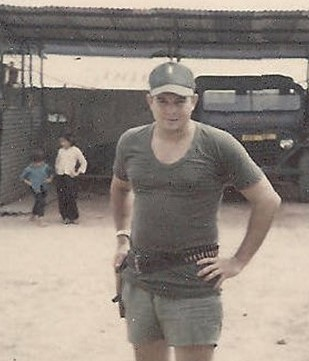
We used to call him’ John Wayne’. I don’t think I ever saw him without at least three or four weapons, and a couple of hand grenades hung from his TA-50 gear. He had been involved in a mortar attack in the compound before I got there and as a result felt that he had to be heavily armed.
As I describe in my book he was involved in an incident involving three Vietnamese children who he inadvertently wounded in an unfortunate incident. He was trying to show off to these kids. The “unloaded” pistol that he fired ended up not only shooting himself and seriously wounding all three of the kids that were standing next to him. He was convinced that the weapon was unloaded but it wasn’t. He returned to the States and was discharged from the army, probably with a disability of some sort. While he was very good at his job he really didn’t understand the weapons that he was carrying.
So, what happened after the war with these men when they got out? Was the training they received of any value to them?
Comparisons between “Project 100,000” participants and their non-veteran peers showed that, in terms of employment status, educational achievement, and income, non-veterans appeared better off. Veterans were more likely to be unemployed and to have a significantly lower level of education. Income differences ranged from $5,000 – $7,000 in favor of non-veterans. Veterans were more likely to have been divorced.
A 1995 review of McNamara’s book, In Retrospect: The Tragedy and Lessons of Vietnam, severely criticized the project, saying that “the program offered a one-way ticket to Vietnam, where these men fought and died in disproportionate numbers. The men of the ‘Moron Corps’ provided the necessary cannon fodder to help evade the political horror of dropping student deferments or calling up the reserves. Another conclusion was that “Project 100,000” was a failed experiment. It proved to be a distraction for the military and of little benefit to the men it was created to help”.
I’ve always thought that the lessons that we learned from Vietnam need to be constantly reviewed. Lowering mental standards to meet recruitment goals has never been a satisfactory way of maintaining a strong National Defense. I saw this back in the 1970s when recruitment was very low when the military dropped its recruiting standards for mental acuity. It was a disaster then, as had been with McNamara’s ‘Moron Corps’.
In today’s modern army it’s even more important to maintain high standards of both mental, moral, and physical fitness. On the modern battlefield every soldier is exposed the combat conditions, unlike the concept of serving in a rear area was in World War II or Vietnam. Even in Vietnam all soldiers had to be combat ready because of the nature of guerrilla warfare. As a result, we need the best and the brightest in the military. Today the training that our military receives is beneficial to what they can do in civilian life as well. The level of technical training, the level of innovation that we deal with and the technological advances that our military is exposed to makes them excellent employees when they leave the service. Today’s military personnel are dedicated, motivated, highly educated, and steeped in outstanding leadership capabilities and training.
The military is not an organization for social experimentation, and that’s what the” McNamara Moron Corps” was all about. It was a way of trying to take people who were unqualified for military service with an idealistic goal of providing them training that they might need to succeed in civilian life. Like all social experimentation that is done with the military it traditionally doesn’t work very well.
If you’re enjoying these blogs, please drop me a comment or if you have any questions that I might answer, submit a comment on the comment pages. I’m always glad to hear from you.
Again, please look at all my books that I have listed. They can be reviewed and/or purchased from Amazon.com with the click of a button directly from my website: http://www.ptaylorvietnamadvisor.com, at Authors Published Works.
The Advisor Series:
- “The Senior Army Instructor; The Paul Tyler Saga Begins” (https://www.amazon.com/dp/BOGSXJ2ZHC)
- “The Advisor, Kien Bing, South Vietnam, 1969-1970. A Novel” (https://www.amazon.com/dp/B09L4X5NQ3)
- “The Province Senior Intelligence Advisor, Kien Song Province 1970-1971; A Novel” (https://www.amazon.com/dp/B0BHL2XCX5)
- “The Hardchargers,” Vietnam 1972-1973; A Novel” (https://www.amazon.com/dp/B0C7SPR1JY)
- “The Tuscarora Trail” (https://www.amazon.com/dp/B0D3QY2GM6)
Civil War History/Fiction:
- “A Civil War History of Harrison County West Virginia 1861-1865” (https://www.amazon.com/dp/ B0B1CLL28Q
- “The Most Hated Man in Clarksburg” (https://www.amazon.com/dp/ B0C6429M1X
Science Fiction: (Chuck Neighbors author, Taylor *editor/**co-author)
- *“Destiny” https://www.amazon.com/dp/B0B6WGWHLS
- *“HomeFall” https://www.amazon.com/dp/B0CJN1JLWF
- **“The Planet’s Revenge; The Katy Sterling Saga Continues” https://www.amazon.com/dp/B0CYQBHC6C
Return to Author’s Published Works
Leave a Reply