Last week I tried to describe our facilities at the MACV Advisor Compound at Moc Hoa in Vietnam. But what was it like living there?
First of all, our conditions were much nicer than that of those guys who lived in the division units in the field. We had a fixed location with many the accoutrements of modern living. We had electricity and lights in every room which meant that rooms could have a fan in them. Our few junior enlisted men were housed two to four men per room on bunk beds. Each room had a wall locker, and the men would purchase furniture in the market downtown and fix the rooms up as they wanted them.
As officers we had individual rooms, most were larger than those occupied by our junior enlisted personnel. Noncommissioned officers were generally housed two to a room, but that varied by seniority. And like everyone else they would adjust furniture to their own liking. It was a lot better than living in a tent out on patrol in the jungle or the rice paddies.
But our mission was different as advisors at the provincial level (think State capital); our living conditions were two or three steps below that of the guys living in Saigon or the major cities.

Our Colonel had his own house that was built off to the side of the compound. It served as his quarters and also as quarters for senior visitors that might visit the team. He had a large screened in veranda at the back of his hooch and we would often meet there for drinks in the evening with him. He had his own cook and maid and took most of his meals in his quarters rather than eating in the mess hall.
The mess hall was an outstanding operation. Our cooks were very good about going downtown and purchasing food on the local market to make sure that we had a variety of vegetables, fruit, seafood, and surprisingly potatoes. They were excellent as far as taking what the Army gave us as rations and turning it into some outstanding meals. Again unlike the guys in the field we were living on rations that were hot and served on tables rather than eating C-rations or hot meals that came from large mermite cans shipped in from the base areas. Usually once a week we would have a steak dinner barbecued outside by our cooks.
I mentioned the fact that they had built a new latrine with a large shower room attached before I got there. We generally had hot water for our showers most of the time. There were times when the water heaters would go down and they would have to work on them but that was a rare occasion. You could walk into the shower at any time day or night and usually find that the water was hot. There was one problem that we had in the shower and that was snakes. Just before you walked into the shower room hanging on the wall was a shotgun. Occasionally a large snake would slither into the shower and for some reason they like to hide immediately next to the step leading into the shower room. The first thing that you would do would be to look over the steps before walking in to make sure you weren’t walking in on a sleeping snake. The ones we worried about most were cobras. Every now and then you would hear a shotgun blast coming from the shower room and you knew that someone had killed a snake. There were large nails that had been driven into the walls on the outer side of the building, and we would take the dead snake and hang it from those nails. In the morning our Vietnamese maids would come in and take the snakes home and cook them up for supper. They would also use the snake skin which they would sell in the marketplace.

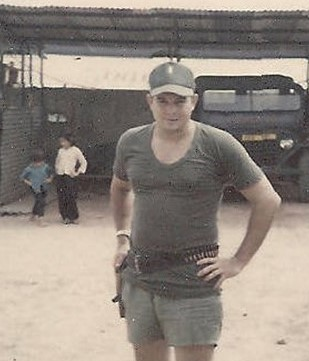
Captain Joel Montgomery in front of Shower room
Everyone could hire a maid to do basic cleanup of our rooms and to take care of our laundry. They were generally paid a few hundred piasters a day (117 piasters = $1.00) by soldiers occupying the rooms. We also had women who ran a laundry service and did minor sewing for members of the team. We had a ‘houseboy’ who worked to polish our boots. Our Command Sergeant Major was very strict with uniform requirements.
Once a week a local barber would come into the compound and give haircuts for about 500 p. One of the enlisted guys would sit in front of him with a loaded pistol while he cut hair. He used a set of manual clippers but also trimmed with sharp scissors and a straight razor. Their presence was to insure the safety of his clients.
We also had a nice little ’all ranks’ club building, for everyone on the team. It had a bar, and served beer, soda, and hard liquor drinks. In the evenings they would show movies that they had picked up in Saigon. We saw a lot of westerns, and cop shows, but occasionally we’d get a relatively first run movie. Occasionally the USO would send a small troop in and they would perform there. I talk in my book about Martha Raye doing a show and what a wonderful performance that she and her troop put on. Martha Raye would bring in a small combo, usually a couple of cute American girls who would sing and dance, and then she would stand up and tell jokes. I think if the Vietcong had even tried to attack the team that there would have been hell to pay on them had they injured any of our USO folks.
We had a communication shack, and they would deliver our communications from Saigon on a daily basis. That actually caused us a little bit of trouble because a lot of it was classified and we had to not only secure it, but we had to make sure that it was properly disposed of. We had a burn barrel, and we would sign a destruction certificate, send it back to the communications shed and they would log it into their system to show that they had given it to us and that we had properly disposed of it.
As the intelligence officer I made arrangements for the intelligence team which consisted of myself, the Phoenix adviser, the Senior Police adviser, and the NILO (Naval Intelligence Liaison Officer) to live in a three bedroom structure that we built. We basically took one of the walls out of the bedroom and opened a door into the third bedroom. This created one large bedroom in the back, and a smaller room that we used as our office and ‘living room’ area. This way I could make sure that all of the intelligence that was gathered was properly shared amongst the Americans. This turned out to be a very good system because the Vietnamese intelligence was very disjointed and we had difficulties getting them to cooperate with one another. But the Americans shared all the intelligence that we had, and we could always go in and somewhat embarrass our counterparts by challenging some of the information that they possessed. It turned out to be a very good system for us.

Intel Hooch, Moc Hoa 1971 (Living Room)
But don’t get me wrong, “Splinter City” was only about four kilometers from the Cambodian border. As a result we also gained the title of “Rocket City” because of the number of rocket and mortar attacks that hit the compound. Every couple of days during the week we would find ourselves in the bunkers at night receiving incoming harassment fire. Fortunately we only had one casualty all the time that I was there, a young specialist who was killed in his room.
Right outside of the compound was a fuel dump. The Vietcong fired a rocket at the compound, and it hit the top of one of the barrels and did not explode. It ricocheted upward and got tangled in one of the telephone lines that ran along that part of the berm, and it fell underneath his room and detonated. He was killed instantly. We had other attacks and we had a couple of incidences where people were slightly injured running to or from a bunker but other than the one death, we didn’t suffer any other casualties while I was there.
But when I try to compare myself to some of the combat soldiers in the divisions it’s difficult. We were in Vietnam, we were under constant threat of attack, we all went on combat missions with our counterparts, but when we came back, we had a decent place to stay, good food, a hot shower, and camaraderie at the club.
If you have any questions about life in “Splinter City” drop me a line.
If you’re enjoying these blogs, please drop me a comment or if you have any questions that I might answer, submit a comment on the comment pages. I’m always glad to hear from you.
Again, please look at all my books that I have listed. They can be reviewed and/or purchased from Amazon.com with the click of a button directly from my website: http://www.ptaylorvietnamadvisor.com, at Authors Published Works.
The Advisor Series:
- “The Senior Army Instructor; The Paul Tyler Saga Begins” (https://www.amazon.com/dp/BOGSXJ2ZHC)
- “The Advisor, Kien Bing, South Vietnam, 1969-1970. A Novel” (https://www.amazon.com/dp/B09L4X5NQ3)
- “The Province Senior Intelligence Advisor, Kien Song Province 1970-1971; A Novel” (https://www.amazon.com/dp/B0BHL2XCX5)
- “The Hardchargers,” Vietnam 1972-1973; A Novel” (https://www.amazon.com/dp/B0C7SPR1JY)
- “The Tuscarora Trail” (https://www.amazon.com/dp/B0D3QY2GM6)
Civil War History/Fiction:
- “A Civil War History of Harrison County West Virginia 1861-1865” (https://www.amazon.com/dp/ B0B1CLL28Q
- “The Most Hated Man in Clarksburg” (https://www.amazon.com/dp/ B0C6429M1X
Science Fiction: (Chuck Neighbors author, Taylor *editor/**co-author)
- *“Destiny” https://www.amazon.com/dp/B0B6WGWHLS
- *“HomeFall” https://www.amazon.com/dp/B0CJN1JLWF
- **“The Planet’s Revenge; The Katy Sterling Saga Continues” https://www.amazon.com/dp/B0CYQBHC6C
Return to Author’s Published Workshttps://ptaylorvietnamadvisor.com/authorspublishedworks
Leave a Reply