During my first year in Vietnam, I lived with two Vietnamese families. When I first arrived, our counterpart was a geographical bachelor. He was from a very wealthy family from Saigon with relatives highly placed in the Vietnamese government. He had been assigned there by the Ministry of Defense and from what we gathered he was there really to do one thing and that was to increase the wealth of his family in Saigon. I had been warned by everyone when I was initially assigned there that he was a crook. He was there to do one thing and that was to enrich the family. He was less than energetic as a field commander. The operations that he personally went on are what we would refer to as ‘mosquito swats’, or ‘walks in the sun’.
A ‘mosquito swat’ was the nighttime ambush that was usually set up around one of the villages. Our counterpart knew that there would be no action there and so he would routinely send a small unit out to be set up near one of the villages. We would usually sit there from about four in the afternoon until about sunup, swatting mosquitoes, while the real infiltration was happening in villages around us.
A ‘walk in the sun’ was just that it was a daytime search and destroy mission usually along one of the canals. It was a way of him imposing taxes on the local villagers.
Being a geographic bachelor, the captain lived in the large house with his ‘niece’. It didn’t take long to understand that the relationship was less than familial. His niece was his mistress. He was expected to entertain as the district chief, and he needed someone to handle preparations for these meetings and events.
The young woman was not very attractive, but evidently, she served his purposes. We rarely saw her. If we saw her, she was in a very menial position. She was to be seen and never heard, and she was rarely seen. When she was visible to us it was always in a very subservient manner. At dinner, for example, she would serve the meal quietly. I made the mistake one time of asking her a question while we were eating about a particular vegetable that I had never seen before. When she started to answer he scowled at her and she immediately bowed her head, put her hands in her lap and said nothing. She would supervise the kitchen help and on formal occasions would prepare tea to be served to guests.
When she entered the room, her face would be always directed at the captain, never to anyone else. When she served the tea, she would back out of the room with her eyes always on the captain. She always had a very forlorn look. I learned quickly that as an advisor we were to have no real personal contact with her.
I saw her in church several times when the Catholic priest would come to town, so we knew that she was a communing Roman Catholic. And when the captain was finally transferred back to Saigon, she was abandoned as a disgraced woman.
Fortunately, when my second counterpart arrived with a large family, this young woman was brought into the household once again to serve as a nanny for his nine children. Rather than being disgraced she loved her new duties and was welcomed into the family. Again, I did not have a lot of contact with her, but we do know that she married well, an officer in the local military unit, and that she ultimately had children of her own.

Our second family was interesting to say the least. Lieutenant Colonel Tua had 13 children. He had been a military attaché in Europe and spoke somewhere between seven and nine languages fluently. His English was excellent. The joke was that I had to follow along with the dictionary to understand some of the things he was trying to say. He had studied civil engineering and had attended the American Command and General Staff College at Leavenworth Kansas.
Family life there was a lot different. We were accused of spoiling his children with candy that we got from our ‘sundry boxes’. We always carried hard candy with us and the children would flock around us asking for candy and we gave it to them freely. They loved watching American television. We had a TV set, and we could watch AFVN television in the evenings for a few hours. Children would pull up our trailer for our Jeep and sit in front of the big window watching TV. We kept a schedule for them so that they knew if it was a cowboy or a police show. They loved both of those. They would sit on the trailer and watch TV and cheer when the good guys won and Boo when the bad boys were doing things that they didn’t like. It was always a lot of fun.

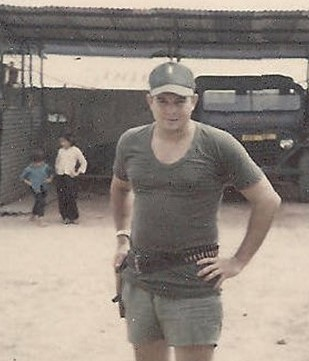
Our District Chief’s House in Ap Bac (Home for first year)
The Colonel and his wife were always apologizing especially for the younger children. They would wander in and out of our area and we had no problems with that. My Sergeant had children of his own and I think that he really enjoyed having the kids around.

Our ‘Kids” at Ap Bac
Initially we always ate our meals with our counterpart but because of the size of his family we ultimately started eating our meals in our own spaces. Our house maid would go to the kitchen and bring our food to us but on occasions we would join the family for celebrations and for big meals.
Every Sunday when the priest was in town Mrs. Tua would dress the kids in their finest and marched them up the street to church. It was always fun to watch; it looked like a mother duck with her ducklings in tow.
The children were always well-behaved, I don’t think we ever had an issue with any of them. The older children took care of the younger ones, and they would play in the yard with their toys.
One of the biggest advantages that we had was the fact that we were able to live within this family setting. It also allowed us to make contacts on a personal level that improved our abilities as advisors. For example, various village chiefs would often meet with Colonel Tua in his office during the day. Each one of them would come down with some type of special request or need to support their village economically or politically or militarily. We found that we were being invited to these meetings more often. As a second Lieutenant I would traditionally just listen, and very rarely interject myself in this conversation with the elders. But it gave me a good idea of what was really happening within the different villages.
When I moved from my district team up to the province team, I maintained the same degree of social contact with my counterparts as I had previously. And as a result, it paid off. After a year in Vietnam my Vietnamese language skills had improved but fortunately for me my counterparts at the province level generally spoke very good English. My counterpart as the S2 had studied engineering at the University of Hanoi, he was a major, and he had learned English in college because of this training. We had very few difficulties in understanding one another. The major was a widower; he had lost his wife and all but one of his children when they were fleeing from North Vietnam because of the expulsion of Catholics. I would often go to his house for dinner.
I was invited to go visit Vung Tau with my counterpart, the Provincial Chief of Police. I visited his family there twice during my stay in Vietnam and it was always an enjoyable social visit.
I managed to develop a junior relationship as a first Lieutenant with the province chief, a senior Vietnamese Colonel, technically holding the rank of Brigadier General in the US army. He was very cordial to me and felt that I was a very lucky officer. I had been involved in some very interesting operations there that had been very, very successful and as a result he felt I had a lot of luck. He appreciated that.
Living and working and socializing with my Vietnamese counterparts improved my success as an advisor. Trying to learn their language helped immeasurably. Even if I did not speak Vietnamese well, they appreciated the fact that I was trying.
So, as you can see the role of the advisor was interesting, detailed, and involved us in all aspects of the Vietnamese culture at all the different levels of society.
If you’re enjoying these blogs, please drop me a comment or if you have any questions that I might answer, submit a comment on the comment pages. I’m always glad to hear from you.
Again, please look at all my books that I have listed. They can be purchased from Amazon.com with the click of a button directly from my website,
The Advisor Series:
- “The Senior Army Instructor” (Available on Amazon ASIN: B0GSXJ2ZHC)
- “The Advisor, Kien Bing, South Vietnam, 1969-1970. A Novel” (Available on Amazon ASIN: B09L4X5NQ3)
- “The Province Senior Intelligence Advisor, Kien Song Province 1970-1971; A Novel” (Available on Amazon ASIN: B0BHL2XCX5)
- “The Hardchargers,” Vietnam 1972-1973; A Novel” (Available on Amazon ASIN: B0C7SPR1JY)
- “The Tuscarora Trail” (Available on Amazon ASIN: B0D3QY2GM6)
Leave a Reply