I know I’ve discussed this before, but I think it often needs some repeating to some degree. When we think about the Vietnam War our mind quickly recalls the movie settings and the concept that the entire war was fought in the jungles of Vietnam by divisional size units. But long before our divisional size units arrived in Vietnam advisors we’re working with the Vietnamese military and civilian government since the early 1960s. While all of the services provided advisory personnel the US Army advisors in Vietnam were the backbone of U.S. military assistance in South Vietnam.
When the major units arrived in Vietnam they often establish massive operational bases, or base camps. These camps often resembled American cities as the war continued. It was not unusual to have barracks buildings, major mess halls and dining facilities, bases in some cases even had movie theaters, PX facilities, swimming pools and recreational facilities on some of the largest of the bases. The units did whatever they could to improve their own living conditions in the base camps so that when the men returned from the fields that they could rest before their next operation. Now don’t get me wrong these base camps weren’t necessarily safe, many of them were under constant artillery, mortar, and guerilla attacks. But these base camps had the advantage of American security.
MACV Teams were out there alone-not on base camps, air bases or at sea. Small groups of Americans were often in remote areas supported only by Vietnamese forces whose capabilities and loyalty were sometimes suspect. In addition, teams served within South Viet Nam’s 44 provinces and over 200 districts.
While some of the larger cities and regional capitals also had develop the base camp concept for MACV personnel the vast majority of advisors didn’t share those luxuries. MACV teams at the district level traditionally consisted of between 7 to 11 advisors. Traditionally there was a Captain, one or two Lieutenants, a senior noncommissioned officer (Master Sergeant or Sergeant First Class) and a group of NCOs who specialized in medicine, small and heavy weapons training, and communications. They often lived in their own small compound, and they did as much as they could to make their living conditions as comfortable as possible. But these small groups were surrounded by their Vietnamese counterparts on whom they relied for the bulk of their support and security.
These small teams were self-sufficient. While they might hire a maid to clean and cook for them they still were responsible for scrounging their own materials, food, supplies, or getting what they could from their Vietnamese counterparts. This lack of support was not done on purpose; it was just the reality of working out in a small district with limited resources.
When I say self-sufficient, one of the men might be a very good cook and would be saddled with those responsibilities of preparing meals, scrounging food, and possibly even doing the cooking for the team.
When their Vietnamese counterparts would go to the field on operations they would generally accompany them. With such a small group of men it could mean that they’d run ambush patrols two or three nights a week, and then return to their small district team headquarters and go right back out on patrol again. While back at the district team they still had their day-to-day responsibilities to perform.
If the team had a aggressive senior counterpart as I did at Ap Bac, An officer and Sergeant might find themselves in the field for considerable amount of time. And upon return to the village/town they might find themselves working for the next few days training, or working with their Vietnamese counterpart. At the end of that day, they might find themselves gearing up for another night operation. While we tried to share those responsibilities as much as possible for a small team it could be very demanding.
Of course, we also were in the army and we had all of the military responsibilities to a higher headquarters that we had to deal with. We were constantly preparing reports, in my case daily intelligence summaries, and working with our counterparts to try to develop their abilities to conduct the war on their own.
I think we were quite successful in the training portion of our operation, I believe that the men that we worked with at our district level we’re quite confident and capable of performing their duties. Once our corrupt captain left, Lieutenant Colonel Tua, our district chief, was a very aggressive and competent tactical and strategic planner and operator. He was also a good disciplinarian, and was able to develop his junior officers to be aggressive in the field. Unfortunately, he was the exception rather than the norm in Vietnam.
Our first counterpart was a crook; he preferred to hide in the headquarters building rather than lead his men in the field. We know that he was on the take, that he was funneling tax money back to his family in Saigon. We also knew that he was “ghosting”, in other words he was reporting 120 men available for pay, and in reality he only had 70 or 80, and he was pocketing the rest of the money for himself.
Corruption was one thing we could not control. In fact, we were advised that we were to overlook it in order to ensure that we maintained a good working relationship with this officer. He was a very poor leader he rarely went to the field, and when he did it was only because he was ordered to do so by our Province Chief. When he did go to the field he conducted what we referred to as ‘Walks in the Sun”. On such an operation he would leave at 9:00 in the morning we would walk along a canal until about noon and then settle in for ‘pot-time’ until about 3:00, at that time he would walk back to the district village and the operation was over.
He would also conduct what we refer to as “Mosquito Swats”. Once a month or so he would go out to the field at night next to a small village and set an ambush for the evening. He would usually take a small guard force with him and spend the night in the village or hamlet with the village chief. We would be in our ambush positions all night! About 10 in the morning after we had not engaged in any contact he would move back to Ap Bac and the mission was over.
He would then provide the Province Chief with some exaggerated report about how he had stopped infiltration and provided security for a village for the evening to counter Việt Cộng operations. He had actually spent a ‘comfortable’ night in the village while his men and advisors swatted mosquitos all night in an ambush position.

One of the difficulties that I noticed immediately upon my assignment at Ap Bac was that my counterpart really didn’t expect me to be around very long. I wasn’t the first advisor that he had dealt with, and this constant rotation of advisors also made it difficult to build long-term relationships with our Vietnamese counterparts. I think he was quite pleased when he found out that I intended to stay for an extra 6 months in Vietnam and extend my tour over there, he felt that he could at least deal with me and that I wasn’t just there for a few months.
The other big issue that I think we all faced was my ability to speak Vietnamese. I was fortunate in that we had an excellent interpreter, and he did a lot to try to help me learn how to speak the language. My counterpart spoke very good English and at least the communications part wasn’t that bad, but when I dealt with the sergeants and some of the civilians in intelligence operation in the District Intelligence Coordinating Center DIOCC they appreciated the fact that I was at least trying to learn their language.
Perhaps one of the biggest advantages that we had as advisors is that we saw the war through the eyes of the Vietnamese people and the villagers that we lived with. I got to see the eyes of the war through the Vietnamese soldiers who weren’t there on a one-year tour but there for the duration. I can remember during my introduction to my intelligence counterpart, a Vietnamese First Lieutenant, he made the comment to me that he had had many advisers over the years and that he hoped that we could do well together. But he also said you will go home and you must remember that when you go home I will still be here. He was there for the duration of the war I wasn’t.
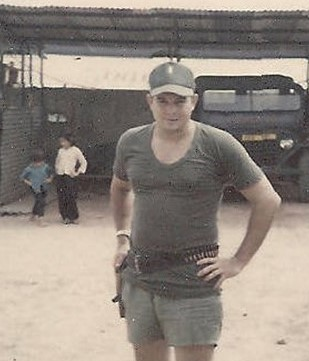
So, we had these small advisory teams throughout the entire country of South Vietnam. Mine was one of the smallest with only three men, a captain, myself as a Lieutenant, and a noncommissioned officer. We relied on each other for everything. We were fortunate the way we were organized that we lived with our district chief, they did all of the cooking and cleaning for us and took care of all the household duties that we would have had to have taken care of had we been out on one of the bigger teams. That was perhaps our biggest advantage, we could spend more time working with our counterparts and less time caring for ourselves.
But the guys in those larger teams not only had their responsibilities as advisors working with their counterparts on a day-to-day basis but they also had the care and cleaning of themselves and their team and the maintenance of their operation.
In both cases we had to rely 100% on the Vietnamese for our security. We trusted our lives with them. I know that we were dealing in many cases with Việt Cộng sympathizers, or at least those who were leery of the government in Saigon. But as in every situation you learned quickly who you could trust and who you couldn’t.
My time as an advisor n Vietnam was deeply fulfilling, and I loved working with the Vietnamese people. They were kind, cheerful, and peaceful, and consistently treated us with dignity, reverence, and respect. Despite how the war ended, I have always hoped that those I worked with would remember us differently whenever a communist leader portrayed Americans as evil: “I knew some good men who respected us and tried to improve life in our communities.”
If you’re enjoying these blogs, please drop me a comment or if you have any questions that I might answer, submit a comment on the comment pages. I’m always glad to hear from you.
Again, please look at all my books that I have listed. They can be reviewed and/or purchased from Amazon.com with the click of a button directly from my website: http://www.ptaylorvietnamadvisor.com, at Authors Published Works.
The Advisor Series:
- “The Senior Army Instructor; The Paul Tyler Saga Begins” (https://www.amazon.com/dp/BOGSXJ2ZHC)
- “The Advisor, Kien Bing, South Vietnam, 1969-1970. A Novel” (https://www.amazon.com/dp/B09L4X5NQ3)
- “The Province Senior Intelligence Advisor, Kien Song Province 1970-1971; A Novel” (https://www.amazon.com/dp/B0BHL2XCX5)
- “The Hardchargers,” Vietnam 1972-1973; A Novel” (https://www.amazon.com/dp/B0C7SPR1JY)
- “The Tuscarora Trail” (https://www.amazon.com/dp/B0D3QY2GM6)
Civil War History/Fiction:
- “A Civil War History of Harrison County West Virginia 1861-1865” (https://www.amazon.com/dp/ B0B1CLL28Q
- “The Most Hated Man in Clarksburg” (https://www.amazon.com/dp/ B0C6429M1X
Science Fiction: (Chuck Neighbors author, Taylor *editor/**co-author)
- *“Destiny” https://www.amazon.com/dp/B0B6WGWHLS
- *“HomeFall” https://www.amazon.com/dp/B0CJN1JLWF
- **“The Planet’s Revenge; The Katy Sterling Saga Continues” https://www.amazon.com/dp/B0CYQBHC6C
Return to Author’s Published Works
Leave a Reply