I had the distinct honor of graduating from the US Army War College, class of 1989. We were all Lieutenant colonels or Colonels, and the purpose of the War College was to train us to look at the military from the highest strategic levels of command. Many of my classmates went on to become general officers in the regular army the National Guard and the Army Reserve. Others, like me, had the opportunity to serve at some of the highest levels of the military in critical staff positions.
In my case when I graduated I was transferred to Norfolk Virginia in a joint staff position working on the senior staff of the Commander in Chief of US Atlantic Command (USACOM). The CINC’s work directly for the Secretary of Defense/War.
One of the perplexing questions that we asked at the War College was why do we go to war?
We would be the generation of senior officers that needed to plan to execute those decisions at the highest levels, and we were exposed to a number of different lecturers to talk to us about that important question dealing with National Defense; when do we fight?
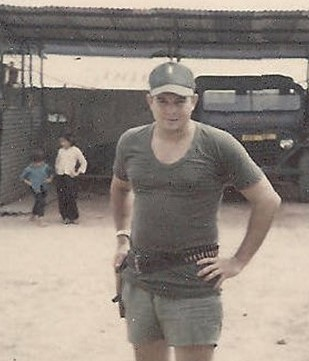
I think this question was especially perplexing to all of us, we had been the young officers in Vietnam. I was there as a Lieutenant and as a Captain. I was one of the officers who left Vietnam on one of the last flights out in March of 1973 when we withdrew our troops from Vietnam. I watched what happened and was mortified by the collapse of Saigon in 1975. Like many Vietnam Veterans I began questioning what had happened there. Should we have been in Vietnam, was it worth the blood and treasure that we spent there? How do we avoid making similar decisions in the future?
One of our guest speakers, Casper Weinberger, a former Secretary of Defense, explained his philosophy on the reasons that the United States should ever enter a war. His approach was called the ‘Weinberger Doctrine’, and his thoughts were designed to guide us in decision making on one of the most critical aspects of military planning and operations; when do we go to war?
He spent time telling us about ‘national interests’. He indicated that the nation went to war to protect its ‘national interests’, but what are they?
Some of them are critical. Others are important, and some are optional. We will go to war immediately to defend the homeland, to successfully conclude major war that we are drawn into, and importantly especially in today’s context, to preserve freedom of movement across free and open air and maritime lanes.
First and foremost, we will defend the homeland. Any direct or perceived imminent attack on the homeland requires immediate response by the military. Our intelligence agencies and military planners work together to ensure that the homeland is safe. That’s the number one mission of the U.S. military.
We have treaty responsibilities as well. Article 5 of the NATO charter requires that we respond to any attack on an allied member of a NATO country. Post 9/11 The United States invoked Article 5 in response to the direct attack on our homeland.
Another very important aspect of our defense posture is protecting both our air and sea lanes. The United States is a maritime trading nation, and we rely on our ability to safely navigate the oceans as well as the skies. Any nation that restricts our ability to move freely through critical choke-points such as the Straits of Malacca, the Red Sea, the Straits of Hormuz, the South China Sea, and other critical choke points where our economic interests are in jeopardy our national economy must be defended. (This is not a commentary on our current Iran involvement over the Straits of Hormuz).
These are our vital national interests and we will fight to defend them.
Then there are a series of secondary issues that may in some cases draw us into a conflict. We have intervened in places like Bosnia for humanitarian operations to protect ethnic minorities from extermination. We have involved our military in narco-terrorism intervention, as well as counter terrorism across the world because they are a ‘clear and present danger’ to the homeland.
And then there is the issue of nation building; probably our most unsuccessful intervention and involvement worldwide. As a Vietnam advisor we spent a lot of time doing the types of things that the American Peace Corps traditionally does. We built bridges and schools, drilled wells and worked to improve the lives and lots of the Vietnamese people. The only difference was, as we used to laugh, between us and the Peace Corps, was that we carried guns. Our attempts at nation building have not been very successful. They have generally led to long and costly interventions such as Iraq, and Afghanistan. None of them have been successful. But such interventions have been thought of as being important.
Many of these types of interventions though also lead to, what we referred to in Vietnam, as ‘mission creep’. During each of my tours in Vietnam my mission changed. When I first arrived, we commanded troops and we fought the war. Later we ‘assisted’ in fighting the war by providing logistical and intelligence support and training to our Vietnamese allies, but we no longer directly commanded those forces. Later in my assignment I was directed to provide only direct intelligence support, and we were no longer allowed to be in the field. On my final assignment in Vietnam, we provided support only, even training a Vietnamese forces changed. October 1969 through 1973 I saw major shifts in the way we operated in Vietnam.
When we look at what’s happened to us in Iraq and Afghanistan ‘mission creep’ was there as well. We went from war fighting to nation building. Nation rebuilding, during the end of World War II, as well as nation building in Korea, worked well. But our experiences in other areas of the world have not been very successful.
Casper Weinberger elaborated on some very interesting concepts. I think they deserve repeating because I think they’re just as valid today as they were during the Reagan administration when he served as Secretary of Defense.
Key Principles
- Commitment of Full Force or Non-involvement:
Weinberger stressed that U.S. forces should only be deployed if there is a clear willingness to commit fully to achieving objectives. Half-measures or partial interventions risk failure and unnecessary casualties.
- Vital National Interest Requirement:
Military engagement is justified primarily when the security or vital interests of the United States are at stake. Regional conflicts without direct U.S. interests should not motivate military action.
- Clear Objectives:
Any military operation must have clearly defined, achievable objectives. Ambiguity in goals can lead to protracted conflicts without tangible outcomes.
- Preconditions and Exit Strategy:
Before entering combat, planners should have a well-defined strategy for success, including guidelines for disengagement or post-conflict resolution to prevent indefinite involvement. Define the mission and accomplish it, then leave.
- Overwhelming Force and Credible Deterrence:
Weinberger advocated for overwhelming force to assure quick and decisive victory. This principle underscores the idea that weaker, incremental force risks failure and may embolden adversaries. We went into Iraq with less than an overwhelming force. We were successful initially, but disappointed when the mission shifted to nation building.He also emphasized calling up the US Army Reserves and the National Guard. The Guard and the Reserves weren’t heavily used in Vietnam. Calling up the reserve forces involve the entire U.S. population. When I went to Vietnam I went as an individual. Other than my parents and friends no one knew I was there. If you call up a local National Guard Unit the entire community is now involved supporting ‘their troops’. Everyone now has sone ‘skin in he game’. Vietnam ultimately became a ‘professional war’, as have ours’s today with the establishment of an ‘all volunteer army’. But war, to be successful, has to be an ‘all or nothing’ involvement. One of the jokes among a lot of officers in Vietnam was, “it’s not the kind of a war we want, but hell, it’s the only one we’ve got!”
- Support at Home and Abroad:
There must be substantial public support and international backing for military engagement to sustain operations. Weinberger emphasized the political legitimacy of U.S. action. This was probably one of his most critical points, that is national support. Baron von Clausewitz reminded us that all wars are extensions of politics by violent methods. Political ends require the support of the American people. Once that support is lost our leaders need to end the confrontations immediately.
- Last Resort:
Military action should be used only after all other diplomatic and nonmilitary means have been exhausted. It is a tool of national policy when all other options fail.
In my lifetime I’ve seen us go to war in Vietnam, Bosnia, throughout the Middle East, assist in nation building, provide humanitarian relief and protection. Vietnam, Afghanistan, and Iraq have proven unsuccessful for a variety of reasons.
In conclusion, our current involvement in Iran is still a matter for future military historians to evaluate. I hope, for our sake, the we follow Secretary Weinberger’s recommendations.
If you’re enjoying these blogs, please drop me a comment or if you have any questions that I might answer, submit a comment on the comment pages. I’m always glad to hear from you.
Again, please look at all my books that I have listed. They can be reviewed and/or purchased from Amazon.com with the click of a button directly from my website: http://www.ptaylorvietnamadvisor.com, at Authors Published Works.
The Advisor Series:
- “The Senior Army Instructor; The Paul Tyler Saga Begins” (https://www.amazon.com/dp/BOGSXJ2ZHC)
- “The Advisor, Kien Bing, South Vietnam, 1969-1970. A Novel” (https://www.amazon.com/dp/B09L4X5NQ3)
- “The Province Senior Intelligence Advisor, Kien Song Province 1970-1971; A Novel” (https://www.amazon.com/dp/B0BHL2XCX5)
- “The Hardchargers,” Vietnam 1972-1973; A Novel” (https://www.amazon.com/dp/B0C7SPR1JY)
- “The Tuscarora Trail” (https://www.amazon.com/dp/B0D3QY2GM6)
Civil War History/Fiction:
- “A Civil War History of Harrison County West Virginia 1861-1865” (https://www.amazon.com/dp/ B0B1CLL28Q
- “The Most Hated Man in Clarksburg” (https://www.amazon.com/dp/ B0C6429M1X
Science Fiction: (Chuck Neighbors author, Taylor *editor/**co-author)
- *“Destiny” https://www.amazon.com/dp/B0B6WGWHLS
- *“HomeFall” https://www.amazon.com/dp/B0CJN1JLWF
- **“The Planet’s Revenge; The Katy Sterling Saga Continues” https://www.amazon.com/dp/B0CYQBHC6C
Leave a Reply